Showing posts with label illegal oaths. Show all posts

Monday, 15 April 2013

15th April 1813: South Wales magistrates express concern that illegal oaths are being sworn amongst ironworkers

My Lord

From the great Depression of the Iron Trade throughout the Kingdom & the manifest loss which the Ironmasters have had & are now sustaining; has Induced those Concernd in the Trade in the Counties of Glamorgan, Monmouth &c. to give notice to their Workmen that they Intend to make a trifling reduction in their wages which it seems have hitherto been higher than in other parts of the Kingdom — Upon this being made known to the men, they have shewn that Spirit of Resistance, by private meetings Swearing or as they term it Twisting in by Anonimous Letters. & in short have been taking the same steps which so much disgraced the workmen in the Northern Counties — We the Undersigned are a magistrate for the County of Glamorgan & Two for the County of Monmouth do Strongly recommend to Government as a matter Precaution to Station a Troop of Horse at Abergavenny & another at Brecknock before the 24th Instant to take the earliest advantage to Suppress any Riots which may occur & we are Apprehensive will happen

We Conceive it would be Prudent not to Inform any one except the Commanding officers for what purpose the Two Troops are sent to Abergavenny & Brecon as it would Cause an Immediate alarm thro’ all the Country

Knowing the Anxious wish which Government always Entertain for the Peace of the Country – we humbly submit that our Representation in this Subject will meet with Attention & we particularly request your Lordships Answer as Early as possible directed to Wm Forman Esqr Merthyr near Cardiff & beg that we may be favord with the name of the Officer each Troop to whom Application must be made in case of Emergency

We have [etc]

William Foreman (Glamorganshire)
Richd Fothergill
Mattw Monkhouse (Monmouthshire)

Merthyr Tidvil
15 Apl 1813—

Wednesday, 20 March 2013

20th March 1813: Edmund Newton walks free from Lancaster Lent Assizes

Edmund Newton, a weaver from Hadfield in Derbyshire, had been taken up as part of the 'Manchester 38' in Manchester on 11th June 1812. At the trial of the '38' at Lancaster Summer Assizes in August 1812, he had been acquitted of being present at the administration of an illegal oath, but was immediately re-arrested on similar charges.

After 9 months in Lancaster Castle, it was now his turn to stand trial at the Lent Assizes, which commenced on Saturday 20th March 1813. He was charged with administering an illegal oath to James Lawton at Hadfield, but the prosecution was not proceeded with. As was customary, the newspapers of the day rarely featured the trials of those acquitted or otherwise discharged, and so we do not have any further details, and there are no papers in the Home Office archive.

Friday, 18 January 2013

18th January 1913: The Prince Regent issues a new Proclamation offering an amnesty for those 'twisted in'

By His Royal Highness The PRINCE of WALES, REGENT of the United Kingdom of Great Britain and Ireland, in the Name and on the Behalf of His Majesty.

A PROCLAMATION.

GEORGE P. R.

Whereas it hath been represented unto us, that divers unfortunate and misguided persons, who have been induced by the artifices of wicked and designing men to take some oath or engagement, contrary to the acts of parliament in that behalf made in the 37th and 52nd years of his majesty's reign, or one of those acts, or to steal ammunition, fire arms, and other offensive weapons, for the purpose of committing acts of violence and outrage against the persons and property of his majesty's peaceable and faithful subjects, and who are not yet charged with such their offences, may be willing and desirous to make a disclosure or confession of such their offences, and to take the oath of allegiance to his majesty, upon receiving an assurance of his majesty's most gracious pardon for such their offences; We, therefore, acting in the name and on the behalf of his majesty, being willing to give such assurance upon such conditions as are hereinafter mentioned, and earnestly hoping that the example of the just and necessary punishments which have been inflicted in the counties of Lancaster, Chester, and York, upon certain offenders lately tried and convicted in those counties, may have the salutary effect of deterring all persons from following the example of their crimes by a renewal of the like atrocities, have thought fit, by and with the advice of his majesty's privy council, to issue this proclamation; and as an encouragement and inducement to his majesty's misguided subjects to relinquish all disorderly practices, and return to their due and faithful allegiance to his majesty, we do hereby, acting in the name and on the behalf of his majesty, promise and declare, that every person not having been charged with any of the offences hereinbefore mentioned, who shall, previous to the first day of March next ensuing, appear before some justice of the peace or magistrate, and declare his offence, and the oath or engagement by him taken, and when and where the same was taken, and in what manner, or the ammunition, fire arms, or other offensive weapons by him stolen, and when, where, and from whom the same were stolen, and the place where the same were deposited, and also, according to the best of his knowledge and belief, the place where the same may be found, and who shall at the same time take before such justice of the peace or magistrate the oath of allegiance to his majesty, shall receive his majesty's most gracious pardon for the said offence; and that no confession so made by any such person shall be given in evidence against the person making the same in any court or in any case whatever.

Given at the Court at Carlton House, the 18th day of January 1813, in the 53rd year of His Majesty's reign.

GOD Save The KING.

Tuesday, 8 January 2013

8th January 1813: The trial of John Baines and others for administering an illegal oath

The last trial that took place on Friday 8th January was that of John Baines the elder (aged 66, a milliner), Charles Milnes (22, a cardmaker), John Baines the younger (34, a cobbler), William Blakeborough (22, a cobbler), George Duckworth (23, a cobbler) and Zachariah Baines (15, a labourer). John Baines the elder was charged with administering an illegal oath to John McDonald (an undercover agent) on 8th July 1812, whilst the others were charged with aiding & assisting him.

James Alan Park spoke first for the prosecution to attempt to differentiate the actions of the spy McDonald from incitement, in that the prisoners were not innocents led to criminal acts by the spy. Park went on to relate what had happened on July 8th. Baron Thomson then summed up the case.

After McDonald gave evidence, he was cross-examined. A constable from Manchester, he had once been a weaver and was originally from Ireland. He was currently serving time in prison after being convicted of an assault, and had been brought to York by Habeus Corpus to give evidence. McDonald’s fellow constable who had been present with him for some of the time, John Gossling, also gave evidence in support.

The prisoners all gave evidence that they were elsewhere at the time alleged by McDonald and Gossling on the evening of the 8th July. They also called witnesses to back this up: John Thomas a master shoemaker from Luddinden in Midgley, employed John Baines the younger, and stated that they were together working on that day until 10 at night, after which they drank beer, with Baines staying the night. Another cobbler, Thomas Cockcroft, stated that he saw John Baines the younger at John Thomas’s the following morning.

William Longbottom, another cobbler, spoke for George Duckworth, stating that Duckworth had come with him on the 8th July to Ovenden before returning to Halifax and working together. They dined and went for a walk later, before returning to Duckworth’s, where Longbottom slept that night.

William Duckworth, George’s father, also spoke for him and confirmed Longbottom’s evidence.

Thomas Helwell, John Baines the elder’s son-in-law and a soldier in the 33rd Regiment, stated that he was with Baines on the evening of the 8th, and remained there until 2.00 a.m. the following morning.

Hannah Crowther spoke for William Blakeborough to say that she had accompanied him on the 8th July to Saddleworth to meet his brother, where they stayed that night and the following 10 days. John Blakeborough, the brother, spoke to confirm the evidence she had given.

The case was summed up by the Judges, and the Jury retired at 8.15 p.m. They returned 5 minutes later to find all of the prisoners Guilty, save for Zachariah Baines, who was found Not Guilty.

8th January 1813: The trials of John Eadon & Craven Cookson for administering illegal oaths

Three trials took place immediately after the execution of Mellor, Thorpe & Smith on Friday 8th January 1813.

Commencing at 11.00 a.m., the first was that of a weaver, John Eadon (aged 34), for administering an illegal oath to Richard Howells between 20th & 21st May 1812.

James Alan Park made it clear to the court that the trials that day were concerned with offences for which the maximum sentence was transportation: no doubt the spectacle of the executions that morning were weighing heavily on everyone present. Although the law had changed making administering illegal oaths punishable by death, Eadon’s offence had been committed prior to the change in the law.

Park went on to outline the case: that Richard Howells lived in the same house as Eadon, at Barnsley. The two men had gone for a walk, and Eadon was alleged to have suggested to Howells that he should become a Luddite, and that if he was interested, he knew a man who could make him one. Howells did not object to the idea, and so Eadon revealed that the man who could do so was, in fact, him. Eadon produced the Book of Common Prayer and administered the oath, with Howells kissing the book at the end. Eadon then gave Howells a copy of the oath in writing, with Park alleging this was Eadon’s handwriting. This copy of the oath was then passed on the 12th June to someone who was to appear as a witness at the trial, a man called Thomas Broughton, who then eventually passed it to Sergeant Prettyjohn of the South Devon Militia, who then gave it to Lieutenant-Colonel Lang in September. Park showed the oath to the Court and read it out:
I Richard Howells I of my own free will and A Coard declare and solemnly sware that I will never reveal to aney to aney Person or Persons aney thing that may lead to discovery of the same Either in or by word sign or action as may lead to aney Discovery under the Penalty of being sent out of this World by the first Brother that May Meet me further more I do sware that I will Punish by death aney trater or trators should there aney arise up amongst us I will pursue with unseaceing vengence, should he fly to the verge of Statude. I will be gust true sober and faithful in all my deailings with all my Brothers So help GOD to keep this my Oath Inviolated Amen.
The Court then went on to hear evidence from Richard Howells, who stated that he did not take the oath seriously at the time – and the defence counsel pounced on this point, arguing that it undermined the whole of the Crown’s case.

One of the Judges, Mr. Justice Le Blanc, responded to this by saying that the indictment was concerned with Eadon’s administration of the oath, and not Howell’s considering it a joke. The other Judge, Baron Thomson, agreed. Le Blanc then summed up the case.

Thomas Broughton, Sergeant Prettyjohn & Lieutenant-Colonel Lang all went on to give evidence about the course of events, as did a Sheffield solicitor employed by Government called Brown.

The Jury went on to find Eadon Guilty.

Immediately after the conclusion of the case, Eadon stood trial again, this time with an accomplice called Craven Cookson (aged 31), another weaver, for administering an illegal oath to Thomas Broughton.

Mr. Park opened the case by stating that as Eadon had been already been found guilty of a similar offence, and because the Crown considered Cookson ‘much less guilty’, he did not intend to give any evidence against Cookson.

Mr. Justice Le Blanc directed the Jury to find both Eadon & Cookson Not Guilty, which they duly did.

Tuesday, 6 November 2012

6th November 1812: Spies report that 'hundreds' of soldiers have been Twisted-in

Staley Bridge Novr 6th 1812

Sir

I have the honor to report that during the week, I have heard from Hayfield, New mills and the different quarters of the Circuit on which I have been lately moving with my Detachment, and I am happy to say, that every thing continues quiet. Clough & Robertson, left this place for Huddersfield this morning, Robertson has some information respecting the Edinburgh Militia, he says, that some hundreds of them were Twistedinn, while the Corps was quartered at Nottingham, this information, I am inclined to receive, with great caution, I cannot help thinking more favorable of them, than that their fidelity to their King & Country should be shaken, by the Nottingham weavers—

Derwent, the Constable, I mean to discharge in a few days, as Captain Raynes & myself thinks, that he is of little service, on this quarter, I will take care to do it in as pleasant a way as I can, but should you have any objections, have the goodness to inform me

I have the honour to be

Sir

Your Most obedient &
humble Servant
Peter Macdougal Capt
Stirlingshire Militia

[To] Major General Ackland
&c &c &c
Huddersfield

Tuesday, 11 September 2012

11th September 1812: John Baines senior, his sons and friends are arrested at Halifax

On Friday night, 11th September 1812, the Stockport solicitor John Lloyd, and General Maitland's aide-de-camp, Captain Thornhill arrived in Halifax. They had obtained warrants for the arrest of several suspects, whom the authorities had known about for 2 months, and arguably set them up.

John Baines senior, and his sons John junior and Zachariah, along with George Duckworth, Charles Milnes (alias Gledhill) and William Blakeborough were all arrested, charged with administering and/or being present at and aiding in the administering of an illegal oath. Milnes and Blakeborough were also charged with stealing lead in order to make bullets.

The authorities in the West Riding had now started to close the net on suspects connected with Luddism.

Sunday, 2 September 2012

2nd September 1812: Four weavers seized at Barnsley for administering & taking Illegal Oaths

Thomas Broughton, a weaver from Barnsley, had become involved with the local Luddites some time ago. Although it is unclear what had driven him to do so, in June 1812 he had approached Major Seale of the South Devon Militia and offered to obtain information for the authorities. Not long afterwards, Broughton met with the local magistrate and MP for the rotten borough of Bossiney, James Stuart Wortley, who directed him on what would be needed for the authorities to act.

By Tuesday 1st September, Stuart Wortley considered he had sufficient reason to issue warrants for the arrest of four men, and the following day they were arrested: the men were Craven Cookson, John Eadon, Stephen Kitchenman & William Thompson, all weavers from Barnsley.

2nd September 1812: The lesser-known cases at Lancaster Summer Assizes

On Wednesday 2nd September 1812, sentencing took place at Lancaster Summer Assizes. A number of cases were decided there which do not usually feature in any of the histories of Luddism, but which nevertheless deserve to be recognised and/or highlighted.

Six prisoners were on trial for rioting at Middleton during the 2-day disturbances in April: they had all been tried for arson at the Lancaster Special Commission in May, but were acquitted, and then immediately charged with rioting to be tried at the next Assizes. Robert Ogden and James Taylor were imprisoned for 18 months, with Paul Greenwood, John Scholes, Abraham Ogden & John Kenyon being imprisoned for 2 years.

Six women who were arrested after the Lancaster Special Commission for taking part in rioting at Barton-upon-Irwell in April were also brought before the Court: whilst Elizabeth Birch, Mary Clare, Mary Dunn were acquitted, Mary Barlow, Elizabeth Benyon & Sarah Parkinson were found guilty and imprisoned for 1 month.

Solomon Low - someone taken up by Captain Francis Raynes during his stay in the area of Mottram - was convicted convicted of having stolen three loads of meal at Ashton-under-Lyne, during rioting in April and sentenced to 6 months imprisonment.

John Brown, the landlord of the Prince Regent's Arms in Manchester, taken up along with Humphrey Yarwood by John Lloyd in June, was not prosecuted for being present at the administration of an illegal oath.

Messrs Rowe & Duncough, the owners of factory at Westhoughton which was destroyed by Luddites in April, brought an action for recovery of their losses against the Hundred of Salford, no doubt because the military failed to act at the time, even though they were alerted. The verdict was given in their favour, and they received 'upwards' of £7000 in damages, and enormous sum of money.

Lastly Edmund Newton, one of the 'Manchester 38', who had been acquitted 5 days before was re-arrested at the end of the trial, charged with administering an illegal oath in Tintwistle and re-committed to Lancaster Castle to stand at the next Assizes.

Monday, 27 August 2012

27th August 1812: The trial of the 'Manchester 38' at Lancaster Assizes

Lancaster Castle c.1830: an engraving by Richard Parry from an original by William Westall
More than 2 months after they had been arrested at a meeting in Manchester, the trial of the 'Manchester 38' began at Lancaster Summer Assizes at Lancaster Assizes on Thursday 27th August 1812.

The trial began between 10.00 and 11.00 a.m., and the indictments were first read. All of the prisoners pleaded Not Guilty. The Counsel for the Crown, Mr. Park (the Attorney-General for the County Palatine of Lancashire) pointed out to the Jury that the effect of the Special Commission in May on the public mind had been diminished because so few people of the thousands that had taken part were tried. He stated that the large number of defendants on trial in this case could have a greater effect, especially as since the 9th July 1812, the penalty for such offences as they were accused of was now death.

Two of the prisoners - William Washington & Thomas Broughton - were charged with administering the oath to the informer, Samuel Fleming, the Crown's star witness. The other 36 prisoners were accused of aiding, assisting and consenting to the administration of the oath.

The prisoners' defence was led by a team that included none other than Henry Brougham, although he was acting only for Thomas Broughton, the man who Park contended was one of the two administrators of the illegal oaths, and the one accused of being most enmeshed in conspiracy.

Park then went on to introduce the Crown's witness, Samuel Fleming, and the events he said he was witness to, setting out the Crown's case. Fleming was an Irish weaver who had come to live in Manchester 9 years ago, a former soldier in Ireland who had joined the Local Militia in Manchester. Park stated that it was 'common practice' to get such men involved amongst the 'unlawful combinations'. The link between Fleming and with what was to occur was Thomas Broughton: Fleming lived in the house where Broughton had resided, and through coming to know him, Broughton had tried and succeeded to get Fleming involved in nocturnal meetings in fields around Manchester. Park contended that Fleming was resistant to be 'twisted in', so much so that one night he was shot at as he was leaving his house. It was at this point that Fleming approached his commanding officer in the local militia, Colonel Sylvester, who was also a magistrate. Sylvester and Joseph Nadin, the Deputy constable of Manchester, now arranged for Fleming to alert them to a meeting, in order that they could make arrests.

The evening of 11th June 1812 came, and Fleming met Broughton at the Elephant public house on Tib Street in Manchester, where a meeting was due to take place. The meeting was later adjourned to another pub nearby, the Prince Regents Arms, in an upstairs room. Broughton & Fleming drank in the bar downstairs, and Fleming at last expressed a wish to be twisted in. Broughton went up and downstairs a couple of times before telling Fleming he could proceed upstairs. Once there, Fleming
contended that he witnessed William Washington administer the oath to 3 other men before he did the same to Fleming. Fleming contended that, after this, Washington gave him the signs and countersigns which could be used to identify another similarly 'twisted'.

Fleming then said he had left at 10.00 p.m. to alert Colonel Sylvester & Nadin, with Nadin then proceeding to the pub with a troop of Scotch Greys and making the arrests, initially of 37 men, as Thomas Broughton was downstairs.

After outlining the case for the prosecution, Park began to examine witnesses, starting with Samuel Fleming. He brought out details, which included an allegation that in being introduced to the political underground by the defendant Thomas Broughton, he had attended meetings in St George's Fields near Manchester, and that on one occasion in the week before the 20th April 1812, there had been an intention to go the Middleton and burn down Burton's steam loom factory.

The defence objected strongly to the introduction of this information, saying that it had nothing to do with the charges, but the Judge, Baron Wood, overruled them.

Park continued to examine Fleming along the lines of the case he had outlined earlier, and got Fleming to state that he had observed the landlord, John Brown, (who was also on trial at the Assizes in a separate case) putting up curtains in the upstairs meeting room before he was twisted in. He also stated that he had talked with a defendant, Isaac Birch: the prosecution was aware that at the hearing where the 38 were initially charged, Fleming had sworn several times that a prison officer called Evans in the lineup was Birch, whilst the deputy constable Nadin had tried to force another defendant, John Knight, to stand near to Evans. Led by Park, Fleming insisted that his identification of Evans for Birch was a mistake, since on the 11th June Birch was wearing a hat all night, and when the 38 were charged, he was not: he insisted that the fact Birch was bald-headed meant that he didn't recognise him without the hat.

Fleming then went on to state that he had been ordered to go downstairs and wait there, and after drinking for a while with Broughton, left the Prince Regents Arms to divulge what had happened to Colonel Sylvester and Nadin.

Fleming was then cross-examined by Mr Scarlett, one of the counsel for the 37 men. Scarlett got Fleming to admit that he went to the meeting on the 11th June, in order to become twisted-in, at the behest of Colonel Sylvester & Nadin, and that Sylvester had given him money since then. Fleming also stated that he had entered the upstairs room at 10.00 p.m., then left to go downstairs, but had not lingered to drink with Broughton, and went straight to Colonel Sylvester's. Scarlett got Fleming to estimate the time taken for him to arrive at Sylvester's house, and then fetch Nadin - he estimated that he did not bring Nadin back before 11.00 p.m.

Scarlett also demonstrated that Fleming was inconsistent about who he knew at the meeting, and how he was then able to identify them when they were charged 3 days later. Fleming admitted that other than 4 people he knew personally, he could not positively say that any of the others were present at the meeting, and that he had not seen them since they were charged over 2 months ago.

At an interval another counsel for the defence, Mr Williams, pointed out that the indictment had Thomas Broughton administering the oath to Fleming, but the evidence thus far had held that he was not in the room at the time Fleming was twisted in, and that this undermined the whole case. Henry Brougham echoed the objection, but it was overruled by the Judge.

Colonel John Sylvester, the Manchester magistrate and Local Militia commander then took the witness stand. He confirmed to the prosecution his earlier contacts with Fleming and also that he had come to him at 11.00 p.m. on the night of the 11th June. Henry Brougham made sure the time was highlighted in his brief cross-examination.

The Deputy Constable of Manchester, Joseph Nadin, next took the stand. In cross-examination by Mr. Williams, he estimated that he arrived at the Prince Regents Arms by 11.30 p.m. and though he insisted he took all the papers from the meeting room, he was clear that he did not find a Bible (the prosecution had alleged that a Bible was used in the oath ceremony). Williams uncovered more inconsistencies in the prosecution's case: they had maintained that Nadin had heard voices calling out numbers when he arrived, and that the front door was locked - yet under cross-examination, he only admitted to hearing the indistinct voices of 2 people talking, and that the door was unlocked - he even pushed it open himself.

When the landlady of the Prince Regent's Arms, Elizabeth Brown, took the stand, the prosecution had difficulty getting her to swear that Thomas Broughton was downstairs on the 11th June, as was outlined in their case. Furthermore, under cross-examination from Brougham, she stated that William Washington did not come to the pub before 10.45 p.m. that evening, which was 45 minutes after the time that Samuel Fleming maintained he had left the public after being twisted-in by him. Mrs Brown also stated that Fleming had arrived at the pub at 7.00 p.m. that evening, before the meeting took place, and had been served 2 pints of beer, but had not gone into the upstairs room at all.

The prosecution's case then drew to a close. The prisoners were asked if they wanted to make statements to the Jury:
Mr. Baron Wood. William Washington, have you anything to say in your defence?

William Washington. My Lord, and Gentlemen of the Jury, if I was not in this situation, but capable of being called upon to give evidence on the present occasion, I should most solemnly state, upon oath, that there is no truth in the charge against us; and I have no doubt, but one and all of my suffering companions would do the same; indeed, by our plea of NOT GUILTY, that declaration is already made by each of us; so that you will have to try on which side the truth lies. For myself, I repeat my innocence; and as a proof of that, I declare, that I was not in the room at the time that Fleming has fixed upon, nor for some time afterwards; in fact, I had been employed and much engaged that evening, in levying an execution, as will be proved to you, beyond the possibility of contradiction, and I was not able, therefore, to go to the meeting till within a quarter of eleven o'clock, when the outward door of the house was shut, as can be proved, as well by Mr. and Mrs. Brown; so that it is utterly impossible that I could have administered an oath to Fleming, or any other man living, at the time, and in the way, I have been charged with. Fleming has said, that the oath was administered soon after ten o'clock, and that the house door was open when he went out; it therefore follows, that as I did not arrive until after the doors were shut, that I was not in the house at the time and suppose so foolishly and wickedly to have acted.—I say foolishly, because I must be considered as the most unthinking blockhead living, and so must also the rest of these prisoners be, if what has been stated be true. But, Gentleman, is it likely that such a body of men, should so far disregard their own safety, as to commit so serious a crime with the room door open, in the presence of so many unknown characters; and more especially so, when you find some intimation had been given of Mr. Nadin’s intended visit?—Such an expectation, if we had any guilty object in view, would naturally have increased our caution, and not slackened it into such indifference. But that is not all—Where is the BIBLE that is spoken of? All our papers were seized, and everything taken from the table, and from the persons of all the prisoners, but yet no Bible, or other book, was found; nor any paper, or other document, confirmatory of the story now told by Fleming; but, on the contrary, every paper seized is consistent with the true motives and object of the meeting, connected as it was with former meetings, to petition for peace, and a reform in parliament. I crave your most serious examination of the facts in evidence, and hope you will compare them, and the nature of the offence charged, with the probability and improbability of the case; after which, I consign myself and all that is dear to me, on this side the grave, into your hands, as an honest impartial Jury of my country.

Mr. Baron Wood successively asked the prisoners, what they had say in their defence? And they addressed the Court the following effect.

Thomas Broughton. There were a few men came to my house, and asked me to go round, to see how many would pay a penny a piece, towards the trial of apprentices.—That was all the meeting I was at.

Thomas Cooke. I have nothing to state.

John Haigh. My Lord, and Gentlemen of the Jury, the first time I heard of this meeting, was on Monday, the 8th June, when a man left a handbill at my house, containing resolutions to petition for Peace and Parliamentary Reform. Another meeting was to take place on Thursday, the 11th June, at the Elephant; I let some of my neighbours see this handbill, and I told them I was going to Manchester; they requested I would endeavour to get a copy of the petition: I was therefore there to hear the petition read, and to get a copy, and nothing else.

Thomas Wilkinson. Gentleman, all I have to say is, that the declaration of Fleming, is totally false: I attended the meeting for the same reason, seeing the handbill.

Charles Oldham. I have nothing more to say, than what has been said.

James Knott. I have nothing more to say, than what has been stated by the others.

Charles Woolling. The things alleged against me are utterly false: coming from my work I heard of the meeting, and merely went to hear the petition and address read.

Robert Thornley. I know nothing of any meeting but this: as I was going from my work, a number of people said, there was to be a meeting, to hear an address and petition for peace and parliamentary reform read: I thought there could be no harm in going to hear them read, and these papers were heard read. As to the charge laid against this, we are as innocent as the child unborn.

Simon Simmons. Some nights before 11th June, being out of employ, I was engaged by the committee to occupy a certain place, to procure names to the petition, and post-up handbills. On Thursday, the 11th June, I was sent for by Mr. Washington, and he desired me to take the book and the resolutions to the public-house; he informed me, he was going to make a levy, and take an inventory of goods, and that he would be there as soon as possible: I went with these things, and left them, and I stopped whilst Mr. Nadin came there.

William Coppock. I was told I was a petition for peace, the Prince Regent Arms, and I went to hear the petition read.

John Oldham. I have nothing to state but what has been stated before.

Aaron Marvell. Gentleman, a few days before the 11th June, a man shewed me resolutions agreed to for a petition and address for peace and parliamentary reform; and he told me of the meeting at the Elephant—I have a great desire to hear them read.

John Howarth, on the 11th June, John Gee came and desired I would go with him to hear a petition the peace read: as my hand was scalded, and I could not work, I agreed to go with him; I stopped till seven o'clock, in the Market-place; I agreed to go to the Prince Regent’s Arms; I went up stairs, and Mr. Nadin came in about half an hour afterwards.

Err Oldham. I have nothing to say, but what has been already stated.

John Kershaw. My Lord, and Gentlemen of the Jury, it is well known by many here, that I was sent to the meeting by the trade: I was appointed to be present by the trade. Me and another person were desired to attend: I had not time to attend at the time proposed, but when I had an opportunity of attending, I went up in my working dress; I went to the Elephant, but the people were dispersed. A man said, is not this a meeting for peace and parliamentary reform? They did not wish to be disturbed. He asked me whether I would go to the meeting at the Prince Regent’s Arms? I thought, as I had promised, I would attend: in consequence of that, I went forward; I staid till between nine and ten o'clock, but no business was transacted—I happened to have no money; I had been to Kersal Moor, seeing the soldiers. This person went out soon after —I sat there while Mr. Knight read the resolutions, until Mr. Nadin came in. I believe it is well known that I abhor such things as we are accused of; I avow eternal abhorrence for the witness has expressed—nothing of the kind was administered, or thought of as an oath.

Charles Smith. On the 21st May, I was informed by Mr. Washington, and Mr. Bent, a respectable cotton-merchant, that in a few days there would be a meeting, for the purpose of considering the best mode of addressing the House of Commons for peace and parliamentary reform. The resolutions, now read, then passed: I was called upon to take the chair, and to prepare the said petition and address. I have, since that night, attended several committee meetings, and the resolutions appeared in the Statesman newspaper, on the 3d June, and it was well known that a public meeting was to be on the 11th June, respecting how funds were to be raised. About half-past eight I was at work, and saw Cannavan; I asked him why did not go to the meeting? He said, it was removed to the Prince Regent’s Arms—I went there; the ranging the company occupied the time till nine, when the resolutions and the address were read. About a quarter past eleven Mr. Washington came in—no oath was administered; and what has been adduced by Samuel Fleming, is utterly false and groundless.

Thomas Harsnett. I have nothing to offer but my positive assertion, that the alleged charge of administering the oath, is a fabricated falsehood.

John Knight. Had not those who have gone before, taken up so much time, I should enter more at large into the nature of the accusation, but as they have sufficiently occupied your attention, I shall be brief:—I was one of the few who were first to go to the room; I staid there till Mr. Nadin came—I solemnly declare, that no such thing as an oath was ever proposed—I deem this sufficient, and as much as if I was to speak an hour.

Thomas Cannavan. What has been adduced by Samuel Fleming, is utterly false, and will be so proved to your satisfaction.

Joseph Tinley. As I stated at the New Bayley, I only went to hear the petition read. I rely with full confidence on God, and the verdict of a British Jury.

John Godley. I went to the meeting for nothing but to hear the resolutions and address read—I went for that and nothing else.

Daniel Jevins. I attended the meeting, for the purpose of hearing the petition and address read.

Stephen Harrison. I have nothing further to say, than what has been already said.—What has been adduced by Samuel Fleming is utterly false.

Edward McGinnes. I have nothing to say, but that no such thing as an oath was ever administered.

James Hepworth. I never heard any thing of an oath named; what has been said by the soldier is absolutely false.

Rycroft Hepworth. What Fleming has said, is absolutely false. I happened to be there, I went to hear the petition read.—Nothing else passed in my presence.

James Lawton. I do not wish to say any thing.

Robert Slack. Gentleman, I have nothing to advance, but what has been said—the accusation is entirely false.

Randal Judson. Gentleman, before the 11th June I heard there was to be a meeting, for an address to the House of Commons, for peace and parliamentary reform, and I attended the meeting with no other view than to hear it read.

Edmund Newton. I went to the meeting, for nothing but to hear the petition read; and I declare, the accusation is entirely false.

Aaron Whitehead. I have nothing to say, but what I stated in my examination. I made it in my way to call at the meeting, when I got to the Elephant I was informed the meeting was removed, and I followed it to the Prince Regent’s Arms. I went to no other purpose but to hear the petition read—I never heard any thing else while I was there.

James Buckley. There is nothing I wish to say.

John Newton. I have nothing to say.

James Boothby. I have nothing to say, but that the accusation is false.

Edward Phillips. I can state nothing, but what has been already advanced.

James Greenwood. I cannot add any thing to what I said on my examination.

Isaac Birch. When I went in I doffed my hat, and never put it on till Mr. Nadin came into the room.
The defence questioned a witness called William Cummins, who had been at the Elephant public house prior to the meeting, and had joined the meeting at the Prince Regents Arms later, leaving at 11.00 p.m. after the landlord had asked that the meeting be concluded. Cummins stated that, as he was coming down the stairs, Nadin arrived. Contradicting Nadin's evidence, he stated that Nadin passed him on the stairs and went into the meeting room, without ensuring that he went back into the room, and that he was later locked out of the pub. Crucially, he also attested that William Washington had arrived at the meeting only a few minutes before 11.00 p.m. Under cross-examination from the prosecution, Cummins further stated that Nadin had ordered him to go downstairs, rather than back into the room, as Nadin had said.

The defence brought another witness, Thomas Hepworth, who was also at the meeting that night. He also stated that he had left at 11.00 p.m. when the landlord asked for the meeting to end, and that William Washington had arrived only 5 to 10 minutes before that.

Both of the defence witnesses who were at the meeting stated that no oaths had been sworn in their presence.

Richard Scott was also a defence witness. He stated that he had been with William Washington in the daytime on 11th Jun, who was working as a general agent (i.e. debt collector) on a job at Gee Cross in Cheshire. They had arrived back in Manchester at 9.00 p.m. and Washington had met Scott at the Sir Sidney Smith pub on Port Street in Manchester for a drink, and had remained there with him until 11.00 p.m.

Thomas Johnson was also called and confirmed that he had been at work with Washington in Gee Cross on the 11th June, and drank with him and Scott at the Sir Sidney Smith, leaving them both there before 11.00 p.m.

Isaac Bland, the landlord of the Sir Sidney Smith was also called by the defence. He confirmed that Washington left at 11.00 p.m. - he stated he remembers the time not only because the clock had struck, but also because his wife had locked the door before eleven and he had to unlock it to let Washington out. He also stated that the clock was set ten minutes early, to induce people to leave earlier than closing time.

Nadin was called again, and challenged about his testimony about seeing a man on the stairs whom he ordered to go back into the meeting room. He disputed this was William Cummins, and stated that the man he saw was bigger in physical build.

The case of the defence was then concluded.

In summing up, the Judge, Baron Wood, highlighted the contrary testimonies as to the time William Washington attended the meeting, and the time Fleming contended he was twisted-in by him: the Judge himself had earlier made a point of asking Fleming what time he left the Prince Regent's Arms, and he had replied 10.30 p.m. He also highlighted the contrary times given for Nadin's arrival, and the fact that Nadin found no Bible, upon which Fleming had attested he had rested his hand to swear the oath.

Baron Wood went on to make it clear that the only evidence for the oath being administered to Fleming was that of Fleming himself, and that several other witnesses contradicted him. Similarly, for the time that Washington had attended the meeting. He commented that it "seems to me, that the witness for the prosecution being so contradicted, it makes an end of the case, and that the
prisoners must be acquitted", but that ultimately, the Jury must decide who they believed.

When the Jury reconvened later, they found William Washington, and all of the other defendants Not Guilty. The trial ended at 2.00 a.m. on Friday 28th August 1812, around 14 hours after it had commenced.

Friday, 24 August 2012

24th August 1812: Convictions at the Chester Summer Assizes

Some of the less well-known convictions for Luddism took place at the Chester Summer Assizes, on or before Monday 24th August 1812. William Cooper, a spy/informer from Newton in Cheshire employed by the Stockport Solicitor, John Lloyd, played an important part. Cooper had been uncovered by the local Luddites prior to the Assizes, and an unsuccessful attempt had been made on his life in July.

Daniel Garside (around 23 years of age) was found guilty of being present at and consenting to the administering of an illegal oath to Cooper, although another man called John Hollingworth charged with a similar offence was acquitted after taking the oath of allegiance. Two other men, George Dernally & Joseph Horsefield, were found guilty of taking the oath, and were acquitted after admitting evidence for the crown and taking the oath of allegiance.

Thomas Schofield was convicted of inciting Cooper to steal a barrel of gunpowder, and also taking an illegal oath.

Although the newspaper reports do not contain details of the subsequent sentences, the Home Office records show that Garside was sentenced to 7 years transportation, with Schofield receiving 4 years imprisonment.

A report in the Lancaster Gazette states that evidence was given about both men convicted, that alleged they had collected money for delegates, and also to pay for Counsel for the 'Manchester 38', whose trial at the Lancaster Summer Assizes was imminent.

The firmness of these convictions, and Cooper's role in it all, is as yet unclear to this historian.

Saturday, 21 July 2012

21st July 1812: A Mason from Manchester informs the Home Secretary that a Luddite has infiltrated a local lodge

Manchester 21st July 1812

My Lord

I have just come to the knowledge of a circumstance, which, I deem of too great importance in regard of our safety, to keep concealed, for a moment, from his Majesty's Government: for, when I consider the introduction of Illuminism into the Lodges of Germany and France, and reflect upon its disastrous consequences to Europe generally, and to France in particular — any attempt, of the people termed Luddites, to disseminate their doctrines with their Oath, into the Masonic institutions of this country, overwhelm the mind with alarm, and seems to demand your Lordship's earliest attentions.—Yesterday, a deputation arrived, at the Lodge of Integrity here, from Eccles, (about four miles distant), to give information to Mr Lynch, (Deputy-Provincial-Grand-Master,) of the suspension of one of their members, on account of an attempt made by him, to twist-in several of the Brethren; and, for his having been, himself+, twisted-in.

All that the deputation wanted was Mr. Lynch's authority to destroy the certificate of the suspended Member, and to request that, the necessary precautions might be, immediately, used to prevent his again ever entering that, or any other Lodge, in the province.

As this was a mere proforma business, I was unwilling that it should here terminate.—I took an opportunity of explaining to Mr. Lynch the facility which the secrecy of masonic meetings afforded to the promotion of seditious plans, and at the same time mentioned the advantage which the Diciples of Weishaupt had taken of this secrecy in promoting the views of the Illuminati.—Concurring exactly with myself in opinion, I proposed to make your Lordship acquainted with the circumstance, and, (if we were fortunate enough to meet your Lordship's approbation,) to search all the Lodges of the county minutely: and, further, to send to every Lodge in our province a list of the names of those men tried and condemned at Chester and Lancaster, with the names of those who have since been taken into custody, the purpose of ascertaining, whether any considerable proportion of these infatuated men were are Masons.—From the tenor of the enclosed oath, we are inclined to believe that, it has been drawn up by disaffected Mason; as, the Oath itself is by no means dissimilar from that one of those, administered to the candidates for one of the degrees of Masonry—

Determined to preserve the strictest silence on the subject, until I have the honor of being made acquainted with your Lordship's pleasure

I am [etc]

Henry Hardie M.D.

To the Right Hon:le Lord Sidmouth

Dr. Hardie
Manchester

+ He is to be tried, at the next New Bailey Sessions, on the above charge.

Saturday, 14 July 2012

14th July 1812: General Maitland suggests a pardon for oath-takers to the Home Secretary

Buxton 14th July
1812

My dear Lord.

I have written to Becket, on the Subject of the French Prisoners, and I am sure you will be good enough to excuse the liberty I have taken.—

In respect to the Measure before Parliament, it will do much upon the occasion, but it has occurred to me, possibly as salutary a Measure as any towards the thing itself, (and to prove the disposition of His Majesty's Government in a most complete manner to avoid all harshness of every kind): would be; If Power were granted to the Prince Regent of pardoning by Proclamation all those who have merely taken an illegal Oath, without being Guilty of any other Offence, upon their coming in and stating it.—

Such a Measure would give the Misguided an Opportunity of coming back, and if not taken advantage of, would shew in the clearest Colours, the Character of their whole Proceedings, it would constitute the whole thing into a mixture of firmness and conciliation, and I apprehend should further Measures unfortunately be necessary, would lay the best foundation for any Application to Parliament.—

In this Opinion I may possibly be wrong, but I am sure Your Lordship will at all events not attribute the suggestion to any improper Motive.—

I remain [etc]

T Maitland

[To] Rt Honble
Lord Visct. Sidmouth
&c &c &c

Monday, 9 July 2012

9th July 1812: The Unlawful Oaths Act becomes law

An Act to render more effectual an Act, passed in the Thirty-seventh Year of His present Majesty, for preventing the administering or taking Unlawful Oaths. [9th July 1812.]

WHEREAS an Act passed in the Thirty-seventh Year of the Reign of His present Majesty, instituted An Act for more effectually preventing the administering or taking of Unlawful Oaths: And whereas it is expedient that more effectual Provisions should be made as to certain Oaths; be it therefore enacted by the King’s most Excellent Majesty, by and with the Advice and Consent of the Lords Spiritual and Temporal, and Commons, in this present Parliament assembled, and by the Authority of the same, that every Person who shall in any Manner or Form whatever, administer or cause to be administered, or be aiding or assisting at the administering of any Oath or Engagement, purporting or intending to bind the Person taking the same to commit any Treason or Murder, or any Felony, punishable by Law with Death, shall, on Conviction thereof by due Course of Law, be adjudged guilty of Felony, and suffer Death as a Felon without Benefit of Clergy; and every Person who shall take any such Oath or Engagement, not be compelled thereto, shall, on Conviction thereof by due Course of Law, be adjudged guilty of Felony, and shall be transported as a Felon for the Term of his natural Life, or for such Term of Years as the Court before which said Offender or Offenders shall be tried shall adjudge.

II. Provided always, and be it further enacted, That Compulsion shall not justify or excuse any Person taking such Oath or Engagement, unless he or she shall, within Fourteen Days after the taking thereof, if not prevented by actual Force or Sickness, and then within Fourteen Days after the Hindrance produced by such Force or Sickness shall cease, declare the same, together with the Whole of what he or she shall know touching the same, and the Person or Persons by whom, and in whose Presence, and when and where such Oath or Engagement was administered, or taken, by Information on Oath before One of His Majesty's Justices of the Peace, or One of His Majesty's Principal Secretaries of State, or His Majesty's Privy Council; or in case the Person taking such Oath or Engagement shall be in actual Service in his Majesty's Forces by Sea or Land, then by such Information on Oath as aforesaid, or by Information to his Commanding Officer.

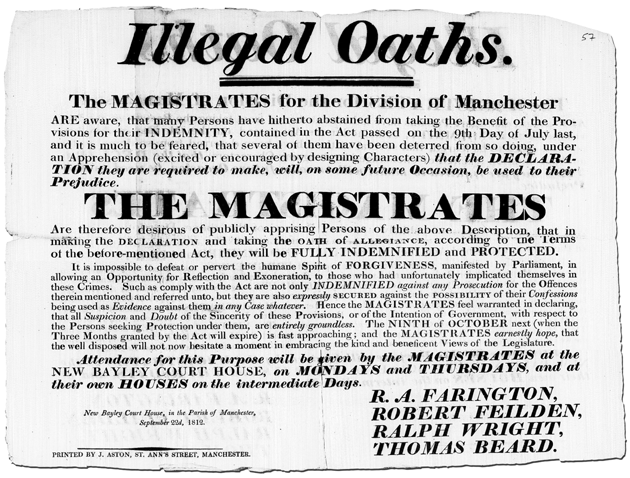
III. Provided also, and be it further enacted, That every Person who before he shall be charged with any Offence under the said recited Act or this Act, in taking any Oath or Engagement described in the said recited Act or this Act, shall, within Three Months after the passing of this Act, appear before some Justice of the Peace or Magistrate, and declare the same, and the Oath or Engagement so taken, and when and where the same was taken, and in what Manner, and who shall at the same Time take before such Justice of the Peace or Magistrate, the Oath of Allegiance to His Majesty, shall be and is hereby indemnified against any Prosecution of any Offence under the said recited Act or this Act; and no Confession so made by any such Person shall be given in Evidence against the Person making the same in any Court or in any Case whatever.

IV. And be it further enacted, that Persons aiding and assisting at the administering of such Oath or Engagement as aforesaid, and Persons causing any such Oath or Engagement to be administered, though not present at the administering thereof, shall be deemed Principal Offenders, and shall be tried as such, and on Conviction thereof by due Course of Law, shall be adjudged guilty of Felony, and shall suffer Death as Felons, without Benefit of Clergy, although the Persons or Persons who actually administered such Oath or Engagement, if any such there shall be, shall not have been tried or convicted.

V. And be it further enacted, That it shall not be necessary in Any Indictment against any Person or Persons administering or causing to be administered or taken, or taking any such Oath or Engagement as aforesaid, or aiding or assisting at, or present at and consenting to the administering or taking thereof, to set forth the Words of such Oath or Engagement, and that it shall be sufficient to set forth the Purport of such Oath or Engagement, or some material Part thereof.

VI. Provided always, be it further enacted, That any Engagement or Obligation whatsoever, in the Nature of an Oath, purporting or intending to bind the Person taking the same to commit any Treason or Murder, or any Felony punishable by Law with Death, shall be deemed an Oath within the Intent and Meaning of this Act, in whatever Form or Manner the same shall be administered or taken, and whether the same shall be actually administered by any Person or Persons to any other Person or Persons, or taken by any other Persons or Persons without any Administration thereof by any other Person or Persons.

VII. Provided also, and be it further enacted, That any Offence committed against this Act, on the High Seas or out of this Realm, or within that Part of Great Britain called England, shall and may be prosecuted, tried and determined before any Court of Oyer and Terminer or Gaol Delivery, for any County, in that Part of Great Britain called England, in such Manner and Form as if such Offence had been therein committed; and if committed in that Part of Great Britain called Scotland, shall and may be prosecuted, tried and determined, either before the Judiciary Court at Edinburgh, or in any of the Circuit Courts in that Part of the United Kingdom.

VIII. Provided also, and it is hereby declared, That any Person who shall be tried and acquitted or convicted of any Offence against this Act, shall not be liable to be indicted, prosecuted tried again for the same Offence or Fact, as High Treason or Misprision of High Treason; and that nothing in this Act contained shall be construed to extend to prohibit any Person guilty of any Offence against this Act, and who shall not be tried at the same as an Offence against this Act, from being tried for the same as High Treason on Misprision of High Treason, in such Manner as if this Act had not been made.

Sunday, 8 July 2012

8th July 1812: A spy sent from Manchester is 'twisted-in' by an old man at Halifax

John McDonald and John Gossling were two assistant constables in Manchester. They had both been sent into West Yorkshire by the Manchester Deputy Constable, Joseph Nadin, with a view to infiltrate clandestine workers' organisations.

The spies arrived in Halifax at noon on Wednesday 8th July 1812 and headed straight for the first public house they could find, the Crispin Inn. After ordering and eating a meal, they left to find somewhere to stay, and having done so, returned in an hour or two. Before long, they were talking to locals, and were soon in conversation with a man called Charles Milnes. They talked generally about the state of the country, and Milnes began to open up about who he knew and what he had been up to; that he had stolen 60 rounds of ball cartridges from a soldier in the Cumberland Militia, but had been found out and had fled when the military searched him and tried to take him before an official. He subsequently hid out on Dean Moor for 3 weeks. He also told them he knew the two men killed at Rawfolds very well, and also another Luddite who had acted as an officer in the attack on the mill. Having gained Milnes confidence, McDonald tried to engage him in talk about how to become involved with the Luddites. Milnes made it clear that before conversation on that subject could go further, he would have to be twisted-in.

After a further discussion, McDonald agreed to the proposal. McDonald later swore that Milnes said "I will take you to a man who has been in the business nearly twenty years, and he will do it for you tonight".

Leaving Gosling behind, the two men made their way to the home of an elderly hatter called John Baines.  Milnes said to Baines "I have brought a friend here; he is a stranger, but he is a very good fellow, and he wishes to be a brother." McDonald noticed that Milnes had raised his voice slightly, and Baines had cupped his ear - the old man was hard of hearing.

"Then we must be handy," said Baines "for we shall have the watch and ward here soon; some of my neighbours have laid an information, and they are often searching my house."

McDonald looked around - 4 others were present, including a young boy, evidently the old man's son. They all sat down together and began to talk. Baines repeated his concerns about the Watch and Ward - McDonald said "I will go as soon as I have done."

The old man then produced a small book, which McDonald assumed was a bible, and bade them all to stand up. Baines' youngest son, the boy who was present & called Zachariah, stood with his back to the door of the house.

The old man Baines said "take the book" and held it out to McDonald, who complied. Baines asked him his name - McDonald lied and said "John Smith", and Baines said "John Smith, say after me;" and Baines administered the oath. Afterwards, Baines urged McDonald to kiss the book, and he complied.

McDonald offered to buy everyone a drink, but the old man Baines declined, owing to the Watch & Ward. Leaving Zachariah with his father, McDonald went out with the others present, they being the old man's other son, John Baines junior, William Blakeborough, George Duckworth, and Milnes. They headed back to the Crispin Inn, with Duckworth deciding to go home before they went in.

In the pub and in the presence of his three new contacts, the spy McDonald boasted openly to the other spy Gossling that he had got himself twisted-in, and Milnes told Gossling he had introduced him. The five men drank and talked more, before they all left the Crispin Inn between 12.00 - 1.00 a.m., with the three Halifax locals walking the spies to their lodgings, none the wiser about their new friend's real identities and intentions.

Wednesday, 13 June 2012

13th June 1812: The 37 prisoners at the New Bailey become the 'Manchester 38' and are committed to Lancaster Castle

Between 4.00 and 5.00 p.m. on Saturday 13th June, the 37 men arrested at a meeting at the Prince Regents Arms on 11th June were in court again, this time facing an examination before the magistrates. By now, they were 38, having been joined by Thomas Broughton, a man who had left the meeting early on the fateful night.

The prisoners had taken their positions up at the bar of the Court, when the Deputy Constable Joseph Nadin spent some time re-arranging them in different positions from those in which they had already stood. Prison officers in plain clothes - 'Turnkeys' - also stood amongst them, and John Knight noticed that Nadin tried to position one of these men next to him. He later managed to slowly move to a different position.

Another man was facing them, Nadin's witness called Samuel Fleming, a man who had left the Prince Regents Arms early on the night of the meeting. Nadin asked Fleming if he knew one of the prisoners, William Washington: Fleming said that he didn't, and Nadin proceeded to point at Washington, saying "That is him, in the striped waistcoat and spotted handkerchief; swear to him first."

Washington realised he was being set up for something, and appealed to the magistrates. When no notice was taken of his plea, Washington appealed again, and this time, Nadin was ordered to move away from Fleming. Fleming then proceeded to swear than Washington had administered to him, and two others, an unlawful oath at 10.00 p.m. on 11th June.

On being asked who else had taken the oath, Fleming pointed out a Turnkey called William Evans, the same man who Nadin had tried to place next to John Knight at the bar. Although he was said he was sure it was Evans, the governor of the prison said it was impossible, since Evans had been at the prison all that night. On being asked to point out the other man who had taken the oath, Fleming pointed to another prisoner, Isaac Birch.

The magistrates refused permission for the solicitors for the prisoners to question Fleming, and the 38 men - from now on know as the 'Manchester 38' - were committed for either administering, or being present at the administering of an illegal oath to Samuel Fleming. The Turnkey, William Evans, was not committed.

Friday, 1 June 2012

1st June 1812: The final prisoners stand trial at the Lancaster Special Commission

On Monday 1st June 1812, the final set of prisoners took their trials at the Lancaster Special Commission.

Three men were accused of receiving an unlawful oath at Bolton on 14th April 1812. It seemed that only one of then, Thomas Holden (20) could be ascertained to have been present by a witness, Isaac Crompton, who said that he was present when he was twisted-in. This was enough for the Jury to find him guilty.

The evidence was not strong enough for the Jury to convict the other two accused - Peter Smith (46) and Thomas Shelton (19), but they now stood charged with riotously assembling on the same night, along with Arthur Holden (33), James Holden (20), William Holden (17) and James Isherwood (26). Their defence pointed out there was a flaw in the indictment (it didn't state that they were assembled for an unlawful purpose), so the prosecution was given up, and the men were acquitted.