My Lord
I have observed in the Papers Reports that numerous Bodies of men assemble in the neighbourhood of Manchester—I have not been able to ascertain that the Reports are correct as far as applies to the immediate neighbourhood of Manchester further than that it is certainly true that a body of about 1000 Persons do assemble in the Evenings near Manchester and the Constables of this Place have endeavoured without effect to learn the Object of the meetings by sending Persons into the Crowd—There is a Disposition which requires to be kept in Check and the utmost Vigilance will be exerted in this neighbourhood —
I understand that a Communication has been made to your Lordship by the Magistrates at Bolton respecting the Situation of Things in that District which certainly have a less favourable appearance and I hope we may ascribe to affairs in this Place—
I have [etc]
Wm Evans
New Bailey Court House
Manchester 30 May 1816

Showing posts with label salford. Show all posts
Showing posts with label salford. Show all posts
Monday, 30 May 2016

Sunday, 1 May 2016
1st May 1816: The Rev WR Hay expresses concerns about discontent in Manchester to the Home Secretary
New Bailey Court House, Manchester. 1 May 1816
My Lord,
It becomes my duty, in obedience to the directions the Magistrates who met this morning in Quarter Sessions to state your Lordship that on Monday Information was received by the Boroughreeve and Constables of Manchester that from conversations which had been overheard, & other circumstances, there was reason to believe that it was not improbable that some disturbance might shew itself in this neighbourhood. It appears that the Weavers, & some other branches of the Manufacturers are for the most part out of employ; and those who are so, talk boldly, and in conversations which have been overheard, they seem to lay great stress on the small number of men in the barracks, which they represent to be only one hundred. I cannot help saying that on coming into Manchester I particularly remarked that parties were assembled in groupes, in the same manner as I have observed in former times of disturbance, in each of which some one seemed to be talking to the crowd around him. The Boroughreeve & Constables early on Tuesday informed me of what they had heard, and I lost no time in communicating with Mr. Evans the Magistrate here, in their company I instantly, as was then settled, wrote in Mr. Evans's name and my own to General Barlow, who we understand to command at Liverpool, informing him generally of the circumstances, & requesting to know, in case of necessity, what force could be brought to bear on this neighbourhood.
The opening of the Sessions I laid the subject before the Magistrates in sessions, where it was of course resolved that these particulars should be laid before your Lordship – It so happened that Major Brice who has the command at Liverpool was today in Manchester. In the name of the Court I communicated with him and with Col Holmes of the 3d (or Princes) Regiment of Dragoon Guards, part of which Regiment is now in the Barracks here. We learn from them that the forces of Cavalry in Manchester Barracks is Rank & file 151 – horses 95 – in Liverpool 261; horses 227 – The infantry under Major Brice does not amount to 500. These particulars I am also directed to lay before your Lordship. How far discontent may spread, and whether it will assume a more serious shape, we cannot judge. But I am desired to state, that in the opinion of the Magistrates, should any commotion take place in this manufacturing district, the force at present here would be found inadequate to the public service.
The Sessions here, from the weight of business, are likely to continue far into next week. Any communication, with which your Lordship may honour the Magistrates will probably arrive during our sitting. At any rate Mr. Evans will be authorized, should the Sessions have finished, to open any letter from your Lordship on the subject.
I have [etc]
William Robert Hay.
To The Rt Honble Lord Viscount Sidmouth
One of H.M’s principal Secretaries of State &c &c
My Lord,
It becomes my duty, in obedience to the directions the Magistrates who met this morning in Quarter Sessions to state your Lordship that on Monday Information was received by the Boroughreeve and Constables of Manchester that from conversations which had been overheard, & other circumstances, there was reason to believe that it was not improbable that some disturbance might shew itself in this neighbourhood. It appears that the Weavers, & some other branches of the Manufacturers are for the most part out of employ; and those who are so, talk boldly, and in conversations which have been overheard, they seem to lay great stress on the small number of men in the barracks, which they represent to be only one hundred. I cannot help saying that on coming into Manchester I particularly remarked that parties were assembled in groupes, in the same manner as I have observed in former times of disturbance, in each of which some one seemed to be talking to the crowd around him. The Boroughreeve & Constables early on Tuesday informed me of what they had heard, and I lost no time in communicating with Mr. Evans the Magistrate here, in their company I instantly, as was then settled, wrote in Mr. Evans's name and my own to General Barlow, who we understand to command at Liverpool, informing him generally of the circumstances, & requesting to know, in case of necessity, what force could be brought to bear on this neighbourhood.
The opening of the Sessions I laid the subject before the Magistrates in sessions, where it was of course resolved that these particulars should be laid before your Lordship – It so happened that Major Brice who has the command at Liverpool was today in Manchester. In the name of the Court I communicated with him and with Col Holmes of the 3d (or Princes) Regiment of Dragoon Guards, part of which Regiment is now in the Barracks here. We learn from them that the forces of Cavalry in Manchester Barracks is Rank & file 151 – horses 95 – in Liverpool 261; horses 227 – The infantry under Major Brice does not amount to 500. These particulars I am also directed to lay before your Lordship. How far discontent may spread, and whether it will assume a more serious shape, we cannot judge. But I am desired to state, that in the opinion of the Magistrates, should any commotion take place in this manufacturing district, the force at present here would be found inadequate to the public service.
The Sessions here, from the weight of business, are likely to continue far into next week. Any communication, with which your Lordship may honour the Magistrates will probably arrive during our sitting. At any rate Mr. Evans will be authorized, should the Sessions have finished, to open any letter from your Lordship on the subject.
I have [etc]
William Robert Hay.
To The Rt Honble Lord Viscount Sidmouth
One of H.M’s principal Secretaries of State &c &c
Saturday, 22 September 2012
Friday, 31 August 2012

Saturday, 28 July 2012
28th July 1812: Captain Francis Raynes expresses concerns about his informer
Kersal Moor Camp
28th July 1812
Sir,
I shall have the Honor of writing to you Sir more particularly tomorrow
I have [etc]
Francis Raynes Capt
Stirling Militia
To,
Major General Ackland
&c &c &c
28th July 1812
Sir,
I had the Honor to state to you in my last Letter that there would be a meeting on Castle Hill last Sunday, it did take place, but was disturbed by two of the Scotch Greys appearing, and one of the men in my employ being declared an informer — I am at a loss what to do with him, for I cannot allow him to return there as I know he will be murdered. His name is Cooper, by Trade a Collier, but goes by the name of Strapper. I shall take care of him till I have the Honor to receive your answer, he may be useful man else where. Thinking this a matter of some importance I took a ride over to manchester in the expectation of having the Honor of seeing you, at the same time to shew you, one of the Notices of the Ludds, for assembling their people. There is to be another meeting on Sunday next at the Carr Meddows betwixt Marple Bridge and Glossop. I would enclose the Printed Notice, but am under the necessity of returning it, to Braddock the man who is to distribute them.
I shall have the Honor of writing to you Sir more particularly tomorrow
I have [etc]
Francis Raynes Capt
Stirling Militia
To,
Major General Ackland
&c &c &c
Sunday, 8 July 2012
8th July 1812: Further information is obtained from Joseph Barrowclough
In the morning of Wednesday 8th July 1812, Joseph Barrowclough was again re-examined and gave more information to the authorities.
Barrowclough named Patrick Doring - who had been arrested the day before in the West Riding for threatening witnesses - and another man called Benjamin Hinchliffe, as the "principle agents in plundering houses for arms" in the Holmfirth area. He named others too - John Shaw being the 'Enoch' (i.e. hammer-man) during the raids, and other men (Samuel Hague, Abraham Armitage, Robert Fitton & Robert Harling) taking part.
Barrowclough described how the commanding Luddites could be identified by their wearing a ribbon on their waistcoats. The ribbons were different colours for the different areas. He also gave more details of the sums of money he alleged were paid to Luddites - contributions being levied and then distributed at a rate of 14 shillings per week.
Lastly, as well as giving physical descriptions of one of the mysterious and anonymous Luddite leaders and a sympathetic printer, he also gave more information about another arms dump.
Barrowclough named Patrick Doring - who had been arrested the day before in the West Riding for threatening witnesses - and another man called Benjamin Hinchliffe, as the "principle agents in plundering houses for arms" in the Holmfirth area. He named others too - John Shaw being the 'Enoch' (i.e. hammer-man) during the raids, and other men (Samuel Hague, Abraham Armitage, Robert Fitton & Robert Harling) taking part.
Barrowclough described how the commanding Luddites could be identified by their wearing a ribbon on their waistcoats. The ribbons were different colours for the different areas. He also gave more details of the sums of money he alleged were paid to Luddites - contributions being levied and then distributed at a rate of 14 shillings per week.
Lastly, as well as giving physical descriptions of one of the mysterious and anonymous Luddite leaders and a sympathetic printer, he also gave more information about another arms dump.
Saturday, 7 July 2012
7th July 1812: Information given by Joseph Barrowclough
Four days after being arrested in West Yorkshire, Joseph Barrowclough had been interrogated by the Stockport solicitor John Lloyd along with Captain John Allison and the Manchester Magistrate the Reverend William Hay. By the evening of 6th July, he had started to give information, and Lloyd & Allison recorded a long deposition on the morning of Tuesday 7th July 1812.
Barrowclough began by implicating a man named Samuel Haigh as the principal assassin of William Horsfall. He continued to describe the origins of the 'Lud System' in Scotland 22 years ago, and described the oath in use. Barrowclough then dropped the bombshell that French prisoners of war were involved with the Luddites.
The rest of the deposition describes the system of arms raiding, even the way raiding parties were organised, as well as the signalling system used. Dates, times and locations were given for future Luddite meetings and well as the location and sizes of arms dumps.
Barrowclough stated there were four principal un-named leaders organising the arms raids, 3 of whom were French, and that they paid out wages to the Luddites in the 24th of each month. He also confirmed that a rising was planned - the "Marriage feast of Mrs Ludd" - which would involve French Prisoners held at Chesterfield, Plymouth and on Dartmoor, but would not take place until the 24th anniversary of the formation of the system - 24th July 1814.
Barrowclough stated there was religious element in West Yorkshire Luddism: "The Luds go by the 21st Ezekiel 25th 6th 7th verses - They call themselves the Godly".
Barrowclough began by implicating a man named Samuel Haigh as the principal assassin of William Horsfall. He continued to describe the origins of the 'Lud System' in Scotland 22 years ago, and described the oath in use. Barrowclough then dropped the bombshell that French prisoners of war were involved with the Luddites.
The rest of the deposition describes the system of arms raiding, even the way raiding parties were organised, as well as the signalling system used. Dates, times and locations were given for future Luddite meetings and well as the location and sizes of arms dumps.
Barrowclough stated there were four principal un-named leaders organising the arms raids, 3 of whom were French, and that they paid out wages to the Luddites in the 24th of each month. He also confirmed that a rising was planned - the "Marriage feast of Mrs Ludd" - which would involve French Prisoners held at Chesterfield, Plymouth and on Dartmoor, but would not take place until the 24th anniversary of the formation of the system - 24th July 1814.
Barrowclough stated there was religious element in West Yorkshire Luddism: "The Luds go by the 21st Ezekiel 25th 6th 7th verses - They call themselves the Godly".
7th July 1812: Colonel Fletcher & his spy, John Stones, observe the 'Manchester 38' in Gaol
In his account of the arrest and trial of the 'Manchester 38', John Knight recounts a chilling episode that took place at the New Bailey prison in Salford on either Tuesday the 7th or Wednesday 8th July 1812:
This was no doubt aimed at fixing any of the '38' that John Stones had come across during his infiltration of the underground workers' organisations during the last few months.
On the 7th or 8th July, Higgins, the gaoler, accompanied by a magistrate of Bolton, named Ralph Fletcher, and a notorious character, of the name of Stones, came into each yard, and ordered in every yard the prisoners belonging to the thirty-eight, to separate themselves from the other, and then viewed our persons minutely, for a considerable time, with earnest attention.
Tuesday, 3 July 2012
3rd July 1812: John Lloyd arrests a Luddite in Yorkshire on the information of his spies
In the afternoon of Wednesday, 1st July 1812, a spy called Thomas Whitehead sent by the Solicitor, John Lloyd, into Yorkshire travelled back to his master at Stockport and informed him that he and his fellow spy, Joseph Taylor, had made contact with a Luddite in Holmfirth.
Lloyd wasted no time in taking a deposition, and then went to Manchester to get a warrant from the Magistrate William Robert Hay before heading into Yorkshire with General Maitland's Aide-de-Camp. They raised troops at Marsden, and after finding the alleged Luddite, a Corporal in the Upper Agbrigg Local Militia called Joseph Barrowclough, they arrested him in the early hours of the morning of Friday 3rd July, bringing him back into Lancashire for questioning at the New Bailey prison in Salford.
The Leeds Mercury and the Lancaster Gazette, both of the 11th July, printed Barrowclough's name. The Gazette also carried an article from the Sheffield Mercury of the 4th July which, although many of the facts were wrong, suggested that someone was leaking information to the Press at a vry early stage:
Over the next few days, under the questioning of Lloyd and Hay, Barrowclough would go on to relate much of Luddite activities in Yorkshire.
Lloyd wasted no time in taking a deposition, and then went to Manchester to get a warrant from the Magistrate William Robert Hay before heading into Yorkshire with General Maitland's Aide-de-Camp. They raised troops at Marsden, and after finding the alleged Luddite, a Corporal in the Upper Agbrigg Local Militia called Joseph Barrowclough, they arrested him in the early hours of the morning of Friday 3rd July, bringing him back into Lancashire for questioning at the New Bailey prison in Salford.
The Leeds Mercury and the Lancaster Gazette, both of the 11th July, printed Barrowclough's name. The Gazette also carried an article from the Sheffield Mercury of the 4th July which, although many of the facts were wrong, suggested that someone was leaking information to the Press at a vry early stage:
On the 3d instant a Luddite of the name of Barrowclough, charged with the atrocious crime of twisting-in, was brought from the edge of Yorkshire to the New Bailey prison, Manchester, in a post-chaise, escorted by a party of dragoons.
The Sheffield Mercury of Saturday last furnishes us with the following information; probably the man in the preceding paragraph is the person alluded to:
“At a late hour last night we received highly important and very gratifying intelligence to every friend of peace and good order. It says that two Bow-street Officers have been in the neighbourhood of Huddersfield for nearly three weeks past, and that they had been Twisted-in, or in other words had taken the oath of the Luddites. By this means they have learned the proceedings and ways of those infatuated persons, and have obtained the knowledge of the depot where their arms were concealed. Warrants were yesterday (Friday) issued the apprehension of fifty of the ringleaders, and in the course of the day great number of them were taken into custody. The actual murderer of Mr. Horsfall was discovered in a house about eight miles from Huddersfield, and is committed to Lancaster Castle* to be tried for the said barbarous deed. He was seized yesterday morning about two o'clock, within the county of Lancaster. The Queen’s Bays were on duty during the whole of Thursday night and yesterday morning; and the Scotch Greys have arrived from Manchester to assist in this business. LET THE GUILTY FEAR AND TREMBLE.”
*This is not correct—Edit
Wednesday, 13 June 2012
13th June 1812: The 37 prisoners at the New Bailey become the 'Manchester 38' and are committed to Lancaster Castle
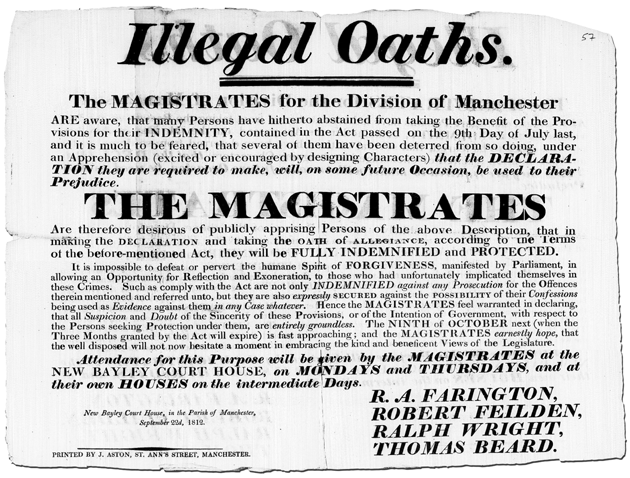
Between 4.00 and 5.00 p.m. on Saturday 13th June, the 37 men arrested at a meeting at the Prince Regents Arms on 11th June were in court again, this time facing an examination before the magistrates. By now, they were 38, having been joined by Thomas Broughton, a man who had left the meeting early on the fateful night.
The prisoners had taken their positions up at the bar of the Court, when the Deputy Constable Joseph Nadin spent some time re-arranging them in different positions from those in which they had already stood. Prison officers in plain clothes - 'Turnkeys' - also stood amongst them, and John Knight noticed that Nadin tried to position one of these men next to him. He later managed to slowly move to a different position.
Another man was facing them, Nadin's witness called Samuel Fleming, a man who had left the Prince Regents Arms early on the night of the meeting. Nadin asked Fleming if he knew one of the prisoners, William Washington: Fleming said that he didn't, and Nadin proceeded to point at Washington, saying "That is him, in the striped waistcoat and spotted handkerchief; swear to him first."
Washington realised he was being set up for something, and appealed to the magistrates. When no notice was taken of his plea, Washington appealed again, and this time, Nadin was ordered to move away from Fleming. Fleming then proceeded to swear than Washington had administered to him, and two others, an unlawful oath at 10.00 p.m. on 11th June.
On being asked who else had taken the oath, Fleming pointed out a Turnkey called William Evans, the same man who Nadin had tried to place next to John Knight at the bar. Although he was said he was sure it was Evans, the governor of the prison said it was impossible, since Evans had been at the prison all that night. On being asked to point out the other man who had taken the oath, Fleming pointed to another prisoner, Isaac Birch.
The magistrates refused permission for the solicitors for the prisoners to question Fleming, and the 38 men - from now on know as the 'Manchester 38' - were committed for either administering, or being present at the administering of an illegal oath to Samuel Fleming. The Turnkey, William Evans, was not committed.
The prisoners had taken their positions up at the bar of the Court, when the Deputy Constable Joseph Nadin spent some time re-arranging them in different positions from those in which they had already stood. Prison officers in plain clothes - 'Turnkeys' - also stood amongst them, and John Knight noticed that Nadin tried to position one of these men next to him. He later managed to slowly move to a different position.
Another man was facing them, Nadin's witness called Samuel Fleming, a man who had left the Prince Regents Arms early on the night of the meeting. Nadin asked Fleming if he knew one of the prisoners, William Washington: Fleming said that he didn't, and Nadin proceeded to point at Washington, saying "That is him, in the striped waistcoat and spotted handkerchief; swear to him first."
Washington realised he was being set up for something, and appealed to the magistrates. When no notice was taken of his plea, Washington appealed again, and this time, Nadin was ordered to move away from Fleming. Fleming then proceeded to swear than Washington had administered to him, and two others, an unlawful oath at 10.00 p.m. on 11th June.
On being asked who else had taken the oath, Fleming pointed out a Turnkey called William Evans, the same man who Nadin had tried to place next to John Knight at the bar. Although he was said he was sure it was Evans, the governor of the prison said it was impossible, since Evans had been at the prison all that night. On being asked to point out the other man who had taken the oath, Fleming pointed to another prisoner, Isaac Birch.
The magistrates refused permission for the solicitors for the prisoners to question Fleming, and the 38 men - from now on know as the 'Manchester 38' - were committed for either administering, or being present at the administering of an illegal oath to Samuel Fleming. The Turnkey, William Evans, was not committed.
Tuesday, 12 June 2012
12th June 1812: The 37 men arrested in Manchester are charged in Court
After their arrest the previous evening, the 37 men from the meeting at the Prince Regents Arms were taken to the New Bailey Prison at Salford, where they were held in a confined space 'crowded almost to suffocation' according to John Knight (1812, p.iii) for between 16 to 17 hours.
Although their jailers agreed to their requests for occasional fresh air and water, requests for a medical examination fell on deaf ears.
Between 4.00 and 5.00 p.m. on Friday 12th June 1812, they were brought before 3 magistrates - Hay, Silvester & Wright. On the oath of the Deputy Constable, Joseph Nadin, they were then charged with 'holding an unlawful meeting, combining for seditious purposes, tending to overthrow the government'. Nadin said he would produce a witness to prove all of this by 10.00 a.m. the following morning.
Although their jailers agreed to their requests for occasional fresh air and water, requests for a medical examination fell on deaf ears.
Between 4.00 and 5.00 p.m. on Friday 12th June 1812, they were brought before 3 magistrates - Hay, Silvester & Wright. On the oath of the Deputy Constable, Joseph Nadin, they were then charged with 'holding an unlawful meeting, combining for seditious purposes, tending to overthrow the government'. Nadin said he would produce a witness to prove all of this by 10.00 a.m. the following morning.
Tuesday, 1 May 2012
1st May 1812: More troops arrive in Manchester & many sworn in under the Watch & Ward Act
On Friday 1st May 1812 600 troops of the Berkshire Militia under Lieutenant-Colonel Ravenshaw arrived in Manchester, having marched from Nottinghamshire.
At the same time, it was reported that 132 people had been sworn in under the Watch & Ward Act for Salford, and 2000 for Manchester and other townships nearby. And most of the Manchester & Salford Local Militia under Colonel Silvester and the Newton & Failsworth Militia under Lieutenant-Colonel Keymer were also called out.
At the same time, it was reported that 132 people had been sworn in under the Watch & Ward Act for Salford, and 2000 for Manchester and other townships nearby. And most of the Manchester & Salford Local Militia under Colonel Silvester and the Newton & Failsworth Militia under Lieutenant-Colonel Keymer were also called out.
Monday, 30 April 2012
30th April 1812: Threatening letter to Nathaniel Milne, Salford Coroner
Sir,
Milnes if you really are not a Friend to the great Oppressors, forgive us this-but if you are-“the rest remains behind”—
Ludd finis est.
This would be an error that our very blood could not expiate, if these lines were stuff’d with nothing but mere malice and injustice; for conscious we are you must at first think so: but if you will take a little advice from a few friends, you will then immediately become an apostate to your principles—The Fable of, “The Plague amongst the Beasts” - is well worth a coroner’s reading—Had some poor man murder’d two or three rich ones in cool blood, Nat. Milnes would then have buss’d in the ears a “Packed Jury" loaded with contagion, these Words, “Willfull murder”—instead of “Justifiable homicide”: but know thou cursed insinuator, if Burton’s infamous action was “justifiable”, the laws of Tyrants are reasons’ dictates—Beware, Beware! - a month’s bathing in the Stygian Lake would not wash this sanguinary deed from our minds; it but augments the heritable cause, that stirs us up to indignation—
Milnes if you really are not a Friend to the great Oppressors, forgive us this-but if you are-“the rest remains behind”—
Ludd finis est.
Wednesday, 25 April 2012
25th April 1812: One man committed for Manchester Exchange riot
The Lancaster Gazette of 25th April 1812 reported that at the recent Salford Quarter Sessions held at the New Bayley prison, a Charles Duffy was before the Judge for "riotously breaking furniture and lamps belonging to the Manchester Exchange" at the riots on 8th April. His case was traversed to the next Quarter Sessions, but being unable to post bail, he was committed to prison until them.
Thursday, 5 April 2012
5th April 1812: Delegates from many North West towns meet at the Kings Arms in Salford
 |
| The Kings Arms, Salford in the 1970s. Image copyright Salford Pubs of the 70s on Flickr. |
The delegates present came from a number of different towns in the North West. According to John Stones, there were 10 present, including 1 from Stockport, 3 from Manchester, 1 from Eccles, 1 from Blackburn and 1 from Bolton. Stones also tells us that the Bolton delegate was a man called Waddington (probably Robert Waddington), who had introduced him to the meeting. Yarwood tells us that a member of the newly-formed Manchester Secret Committee - John Buckley Booth - was there, and that delegates were also present from Saddleworth, Ashton-under-Lyne and Oldham, with a delegate from Failsworth no doubt being counted by Stones as being from Manchester. Thomas Whittaker names the Stockport delegate as Thomas Miller.
Stones reported that the delegates all stated their Towns were 'ready', and that were now waiting on Bolton. Delegates gave numbers for those 'twisted in' in the townships: 823 in Stockport, of whom 250 had arms or other weapons; 2000 in Manchester, which as well as workers included Manufacturers, Publicans and Shopkeepers; even Eccles - which had only been recruiting for a fortnight - had managed to raise 183 and had access to 200 stand of arms because a Local Militia sergeant had been twisted in. According to Stones, all were clear that their aims were no longer limited to an advance of wages - they wanted to 'put the great men down that had trampled them under for so long'.
According to Stones, the meeting set a date for the 'Firing of Factories' to take place in each of the Towns that had sent delegates - the evening of Monday 13th April between 12 midnight and 1 a.m. Waddington said that Bolton was not ready, but the other delegates said that something had to happen in that area and soon - it was suggested that the steam loom factory at Westhoughton should be included in the factories to be attacked, unless another arrangement was made at a meeting due to take place on Wednesday 8th April. Yarwood states that the towns were given autonomy to 'choose what mischief they thought proper' for the 13th, but that the Manchester districts had to agree to it.
Whittaker stated that Thomas Miller had reported that a Bolton delegate (either Waddington or Stones) had brought a scale model of a pike along to the meeting. He describes how Waddington placed the constituent parts of the model pike on a table, with everyone puzzled as to what this was and what he was doing. Waddington then assembled the parts to demonstrate that what looked inoffensive could be made into a deadly weapon. Given that Stones was a member of the Bolton Local Militia, and that Waddington knew this, it would seem to be likely that Stones was the man with the pike, even though he doesn't mention it in his report.
Yarwood tells us that the next meeting was due in a fortnight, 19th April.
Stones left the meeting with Waddington to return to Bolton, presumably on foot because Stones relates how they met a man in Swinton and engaged in conversation, persuading him to join their cause. They were ready to twist him in there and then, but they did not have a copy of the oath on them, and directed the man to get the Eccles delegate to arrange this. The Swinton man estimated he could get 100 other local men involved.
On their journey home, Waddington told Stones that he believed figures such as Lord Cochrane, Sir Francis Burdett and Samuel Whitbread would join them when the country was ready. There was an intention to seize the arms and ammunition belonging to Bolton Local Militia, and he had invited Stones because he trusted him, having heard how he and his father were so active. Waddington told Stones that the secret committee at Bolton had arranged to procure 6 artillery pieces, under the direction of a man called Ratcliff who had used them in the military. They also knew where to get hold of Pikes.
Sunday, 25 March 2012
25th March 1812: Manchester 'Church & King' loyalists petition the Borough Reeve for a Public Meeting
Manchester, 25th March, 1812.
TO THE
Boroughreeve and Constables
OF THE TOWN OF MANCHESTER.
GENTLEMEN,
WE, whose Names are hereunto subscribed, request you will convene a PUBLIC MEETING of the Inhabitants of the Towns of Manchester, Salford, and the Neighbourhood, to prepare a dutiful and loyal ADDRESS to his Royal Highness the PRINCE REGENT, expressive of the strongest assurances of our attachment to his Royal Person and of our ardent zeal for the support of his Government.
Jas Ackers.
R. A. Farington
J. Silvester
Hy. and John Barton
T.O. Gill
Thos. Johnson
T. Blackburne, L.L.D Warden of the Col. Church
Lawrence Peel
William Mayor
John Walker
Robert Peel
Edward Cheschyre
Thos. Jackson
Otho Hume
Thos. Hartmann
Wilson and Williamses
Samuel Smith
Dauntesey Hulme
Jonathan Beever
J.L. Philips
Joseph Seddon
John Parker
James Braddock
Ralph Ellam
Thos. Blackwall
Thos. Watkins
Jno. Pryce
C.W. Ethelston, Fel. of Christ Col.
Samuel Gardner
Wm. Cooper
S. Hall, Clerk, St. Peter’s
John Hull, M.D.
John Bill
Thomas Potter
John Wilson
H. Brottargh
Thos. Hewitt
Samuel Unwin
Jno. Kelsall
James Gordon
Abm. Haverhill
Geo. Grundy
Hen. Fielding & Brother
Thomas Darwell
Jonathan Dawson
R.W. Kitler
Wm. Tate
Richd. Barlow
John Orford
John Collins
Nath. Milne
Thos. Redhead
James Alsop
John Gatliff, Fellow of Christ Col.
Geo. Gould
C.D. Wray
Fred. Maude
James Bateman
Radfords & Waddington
Wm. Harrison
John Holford
Francis Philips
Robt. Hindley
Saml. Bayley, jun.
Thos. Marriot
Samuel Edge
Nath. Hayward
John Foole
Salter, Thompson & Co.
Josh. Denison
Js. Potter
Jeremiah Whittenbury
T.A. Ward
John Clowes, Fell. of Chr. Col.
Francis Parker
John Parker, jun.
John Miller
Thos. Stone, Cheetham's Library
James Harrop
Jer. Smith, Hd. Mas. of the F.G.S.
Jos. and Saml. Ryle
Hutchinson, Mallalieu, and Co.
Fogg, Birch & Hampson
John Ratcliffe
John Ollivant
James Cooke
Geo. Gardner
Rich. Shelmerdine
Danl. Phillips
Chas. Wheeler and Son
John Greaves
Richard Clogg
Edwd. Norris
Robt. Duck
J.R. Saunders
John Arrowsmith
Robinson, Nickolls & Co.
James Clough, M.D.
John Close
Robt. Hayworth
Allen, Bradley and Co.
Thos. Geary
Micah Rose
Thos. Challender
Staines and Mottershead
James Wright
James Bayley
Jackson, Rushforth and Scott
Joseph Heaton
G. .I Noden
Joseph Gould
James Ingle
Henry Bellott
Edwd. Smyth
Rd. Gould,
John Satterfield
Thos. Dunnington
T. Gaskill
J. Frith
Thos. Ollier
Geo. Darwell
R. Whithington
Thos. Atkinson
Geo. Kirtley
Wm. Grant and Brothers
Wm. Townend and Sons
Jos. Gould, jun.
Thos. Fosbrooke
Chas. Weston
Jno. Stacey
C. Parker
John Haigh, jun.
Geo. Webster
Danl. Lynch
Richd. Alsop
Thos. Scholes
John Hurst
Robt. Milne
R.H. Whitelock
Arth. Clegg
M. Randall, A.B.
Wm. Sergeant
J. Clowes, St. John's
Jno. Leaf
Nathl. Gould
IN compliance with the above Requisition, Public Meeting will be held in the Dining Room, at the Exchange Buildings, on Wednesday the 8th April, at 11 o'clock, for the purpose therein stated.
RICH. WOOD, Boroughreeve.
EDW. LLOYD, JAS. KEARSLEY, Constables.
Saturday, 11 February 2012
11th February 1812: Stockport solicitor John Lloyd writes from the New Bailey prison, Salford

Manchester
11 Feb.y 1812
My Lord
As much may be said about one part of the Country connecting itself with the principles of the Nottingham rioters or Luddites, which there was every reason to expect when your Lordship was down in the Country – I think it my duty, as I have a few minutes time here to give your Lordship a sort of prelude to what may (or may not) happen —
Anonymous Letters have been sent to the Magist Mr Prescott threatening to destroy the Machinery employed in weaving by steam rotary motion and a paper signed by a number of Weavers in the nature of a Requisition has been handed to the Rector; by which it appears they desire to meet the Manufacturers
— Information has been given that subscriptions have been solicited in this part of the Country for the Nottingham Rioters — Mr Prescott wishing to consult the parties interested fixed to meet them at my office at 8 o'clock this Evening — but finding myself here at 9 o'clock in the Evening without the least nourishment since Breakfast owing to the circumstances. I will mention I found it would be impossible to get home time enough to act in any way at that meeting – especially as I had to return further to attend the Justices at 9 o'clock in the Morning –
Mr. Marsland's extensive factory on Oxford road has been attempted to be fired but was timely discovered & preserved. Suspicion fell upon certain persons & they have been taken into custody and are now at the New Bayley here & the whole of my day since 9 o'clock this Morning has been occupied in the investigation & I have not the smallest doubt but the magistrates will be induced by what I have & can lay before them to commit some of the parties to Lancaster to take their trials at the Assizes — I have very strong proof of its being wilfully set on fire – & I dare in my conscience fix on the very person that did it & that person is now in custody – and I have had him under Examination this day —
A very serious fire took place in the Town on Sunday in a extensive warehouse in High St belonging to Haigh Marshall & Tideswell & this was threatened in March last by letter signed C.P. Clonmell which I have this day seen in the Police office — It is consequently supposed to have been wilfully set on fire. There were goods to the amount of 100,000l in the Warehouse but only a part were consumed the insurers therefore (being 30,000l) will cover the loss to the owners.
The first act of irregularity or rather of hostility on the part of the weavers in our Town I will take advantage of, if I am permitted, & proceed decisively against them for I am persuaded by reflection and experience that it will not answer to the Country the Governmt or themselves to use a temporizing policy — Perhaps I may not approve the measures that will be adopted this night & I am well away from taking a part but I beg your Lordship will not notice this expression for I may not be so capable of Judging properly as others —
I have taken a national & political view & find that the more we advance our country in arts & improve our manufacturing the better able are we to cope with the common Enemy – whom we can meet in the Market (as well as in the field) with fair competition and keep the Market by the excellency of our Improvements. And shell a set of obscene Individuals who possess no interest or feeling for their Country’s honor dare to dictate to a Government or to the proprietor of a Manufactory of this sort what they shall do or what Machinery they shall use?
But your Lordship I am sure will forgive me if I conclude rather abruptly with a promise to renew the subject when there is something fresh to communicate — for the time for the post office is arrived –
I am my Lord
Your Lordship's very
obedient & very
humble servant
J Lloyd
[to] Lord Viscount Bulkeley &c. &c.
Subscribe to:
Posts (Atom)